

Sip Your Way to Better Health: An Anti-Inflammatory Smoothie Recipe
This anti-inflammatory cocktail is a lively, botanical twist on the classic Whiskey Smash. Created by apothecary bartender Cassandra Sears, this wellness-inspired cocktail combines Reishi mushroom extract with antioxidant-rich ingredients for a medicinal – and delicious! – bourbon cocktail.
The following excerpt is from Botanical bar crafts By Cassandra Elizabeth Sears. It has been adapted for operate on the Internet.
Inflammation and the stress response
Inflammare is a Latin word meaning “to set on fire.” Everyone knows that inflammation can cause body tissues to become red, swollen, scorching, and sometimes painful, but we often don’t look for the cause. Inflammation is a natural response to heal and repair, but if left unresolved or out of balance it can cause maladaptive disease.
Inflammation is the body’s innate immune response
This includes changes in basic structural barriers such as skin, mucosal surfaces, and other inherent features such as mucus.
The stress reaction is a cascade of chemical events that unfold as a physiological response to perceived stress or actual physical stress. The stress response, also known as the fight or flight, is the body’s way of protecting you from harm. The adrenal glands produce and release adrenaline, which causes blood vessels to constrict, increasing blood pressure. The bronchioles dilate, increasing oxygenation. A cascade of precursor hormones mediated by the hypothalamic-pituitary-adrenal (HPA) axis in the central nervous and endocrine systems causes the release of the steroid hormone cortisol, which in turn causes the release of glucose from the liver. Chronic exposure of blood vessels to glucose can lead to cardiovascular disease and cholesterol imbalance.
Most of us live in a state of chronic stress, and we often rely on this natural, adrenaline-rich response to enhance productivity and maintain a speedy pace.
Our ability to respond to stress defines our strength as individuals and collectively. We are on a continuum encompassing the trajectory of life and health, a line pointing upwards and downwards – upwards is the necessary challenge of adaptive capacity, and downwards is degeneration.
It is vital to consistently move upwards and expand your personal capabilities. But it’s equally vital not to push yourself to the breaking point, because if you don’t adapt and start sliding downhill, problems can easily snowball. Our survival instinct tells us: adapt or die.
Epigenetics research proves how vital our everyday choices are, changing the fate of genetic expression and the way our DNA is read at a given moment, which gives the individual the ability to exercise agency and responsibility for his or her own health. Illness and health are not accidental; nor do they result from the victim’s genetic bad luck. Someone may have inherited many “bad genes”, but… the choices they make – including what phytochemicals they put into their bodies through diet and herbal tonics, as well as immersion in nature and exercise – determine the impact on their health. Dynamic (intentional) recovery rest when the body needs it is still an busy evolutionary step!
Adaptogens is a class of herbs imperative for generating physiological immunity in times of chronic stress. These are non-specific and non-toxic drugs that can promote neuroplasticity (adaptability), preventing excessive cortisol production and the knock-on damage that can result. These plant substances may prevent abnormal endocrine functions such as adrenal insufficiency or burnout and immune deficiencies.
Chronic inflammation
Inflammation in response to injury or infection is an vital part of the immune response that determines healing. Problems arise, however, when there are more inflammatory stimuli than the body can handle and the body never has time to subside and heal. It is chronic inflammation, which is defined as inflammation that lasts longer than two weeks and causes tissue damage. Chronic inflammation and stress are interconnected, repeatedly causing each other, and both underlie many current disease states.
There are two types of immunity: innate and acquired. Innate immunity is general, messy and automatic, whereas the adaptive immune response is highly specific and relies on an individual’s immunological memory.
Oxidative stress is a condition in which excess free radicals circulate throughout the body. A free radical is simply a molecule that has an unpaired electron. The formation of free radicals is a normal part of metabolic processes, but when there are too many of them they can cause damage. Too much of this instability is the embodiment of chaos; it can cause DNA damage and genetic mutations that lead to premature aging, as well as heart disease and cancer.
Inflammation and our moods
There is a close connection between mood and inflammation, especially in people suffering from anxiety and depression. People living with chronic inflammation may have problems with impulse control, making risky decisions. The gut plays a key role in mood regulation because most serotonin is produced in the gut.

A pro-inflammatory lifestyle includes insufficient sleep, excessive alcohol consumption, dehydration, smoking, inactivity, eating foods that are not food, and excessive physical work or exercise that does not allow for recovery periods.
In general, antioxidant-rich plants reduce inflammation. When faced with pain caused by inflammation, many people rely on nonsteroidal anti-inflammatory drugs such as aspirin and ibuprofen, which block the production of prostaglandins, hormone-like chemicals responsible for inflammation and pain, as well as swelling. Some plants are high in salicylates, which is a key ingredient in aspirin. Some medicinal mushrooms contain beta-glucans, which aid move the body from the scorching inflammatory state of innate immunity to a more knowledgeable adaptive (immunomodulatory) response. Additionally, soothing herbs, affluent in polysaccharides, have a direct soothing effect on the tissue. They promote the terrain necessary to the body to facilitate repair. Terrain is a metaphor used by herbalists to talk about the holistic health of living tissues.
Anti-inflammatory cocktail recipe: Gates of Immortality
Reishi mushrooms have been used as an elixir of immortality for over a thousand years in customary Chinese medicine.
In this apothecary twist on customary Whiskey Smash, the antioxidant and anti-inflammatory power of shadowy berries and mint, along with the graceful wild beauty of elderberry and hawthorn, are the perfect complement to reishi.

For 1 cocktail
- Handful of mixed fruits: wild blueberries, raspberries and cherries 11/2 oz (45 ml)
- bourbon 1 oz (30 ml)
- fresh lemon juice 1/2 oz (15 ml)
- honey syrup 1/4 oz (7.5 ml)
- elderberry flower liqueur
- 1 drop of Reishi tincture (recipe below)
- A few drops of hawthorn flower essence (recipe below)
- Club soda
- 2 sprigs of fresh peppermint for decoration
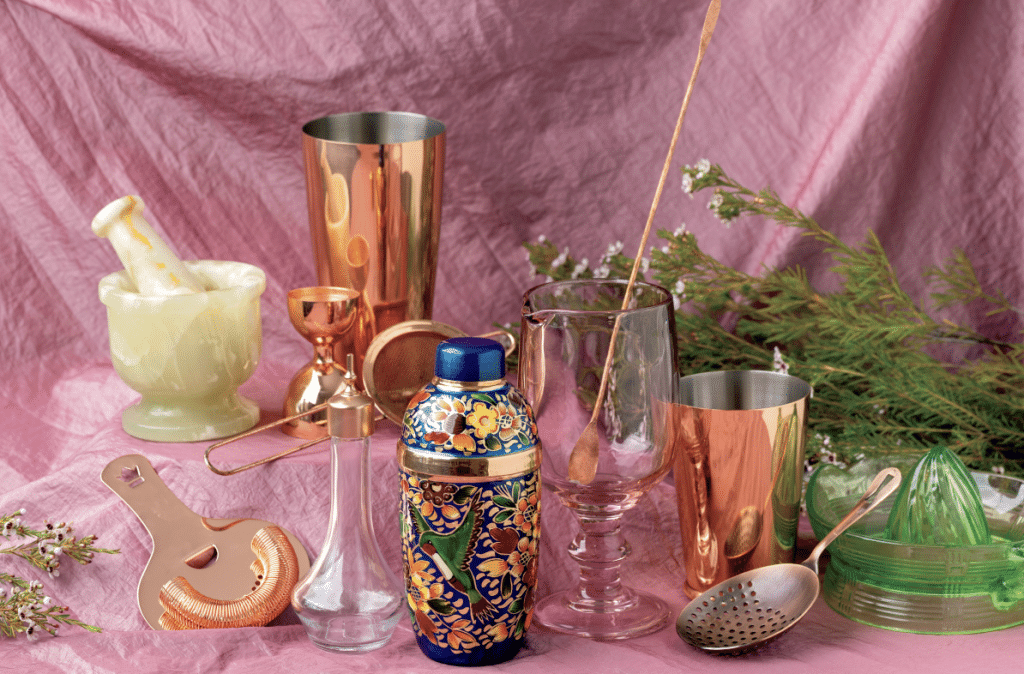
Crush (mash) the blueberries and cherries in a shaker, then add the bourbon, lemon juice, honey syrup, liqueur, Reishi tincture and flower essence. Shake and strain twice into a Collins glass or Mason jar with ice. Top up with club soda. Before placing mint sprigs as decoration, lightly caress or clap them.
NOTE: Hawthorn tincture can be replaced with tincture if hawthorn flower essence was not made in spring.

This was a fun project, growing mushrooms on the kitchen counter and then making a double-extracted Reishi tincture using North Spore Reishi fruiting blocks.
Reishi tincture
Mushrooms contain both polysaccharides, which are soluble in water, and beta-glucans, which are soluble in alcohol. For this reason, I make a double extraction tincture to capture both ingredients. Basically, you create two extracts that you combine together.
Makes 1 pint (480 ml)
- Fresh reishi mushrooms, chopped
- 95% ethanol
Chop fresh reishi mushrooms to fill a 1/2-liter jar and pour 95% ethanol. Also start drying some Reishi mushrooms for a water-based decoction.
Leave the mushrooms in ethanol extraction for 4 weeks, shaking occasionally. By the time the alcohol tincture is ready to strain and squeeze, the mushrooms will be desiccated and ready for extraction in water.
Add the dried mushrooms to the leisurely cooker with enough water to cover them. Heat over high heat for 1 to 2 hours, then lower the temperature and simmer for about 8 hours. Strain the scorching extract. Combine alcohol tincture and water extract in a 50:50 ratio.
Hawthorn flower essence
Makes 1 pint (480 ml)
- Hawthorn is blooming
- Well water or spring water
- Brandy
The process of making flower essence is an integral part of her medicine. This process involves meditation and resonance with the flower in its surroundings. Generally, you will collect hawthorn flowers (Crataegus spp.), which open in spring in Maine at about the same time as apple blossoms.
On a sunlit day, prepare a petite glass bowl with well or spring water and check that your clippers are tidy. Sit by a hawthorn tree and watch its flowers full of bees. Breathe and meditate with the tree for 10 to 20 minutes. Then, without touching the flowers, operate the clippers to cut a petite bunch into a glass bowl. Place the bowl under the tree and leave it there for a few hours. When you return for the flower essence, take some brandy, the funnel, and the shadowy amber bottle with you. Using a funnel, fill the amber bottle halfway with magical water from the glass bowl. Then fill the top with brandy.
From garden to glass – creating botanical delight
ABOUT Botanical bar crafts
This book is both a herbalism book for bartenders and a mixology book for herbalists. My goal as a herbalist bartender is to operate the bar as an engaging platform for teaching about plants. In this book, I invite you to the fantastic and magical green kingdom of plants – a colorful place of plentiful abundance, arousing unlimited curiosity.
Join me at the intersection of herbalism and craft cocktails. Both places inspire, stimulate the senses, are fully alive and free.
“In this lovely and innovative book, Cassandra combines the time-honored art of cocktail making with a fresh approach to incorporating botanicals into drinks that build wellness and taste delicious!”