

Step-by-step guide: How to grow oyster mushrooms on straw
Oyster mushrooms are the second most widely cultivated and popular edible mushrooms in the world. Growing oyster mushrooms on straw is a surprisingly basic method of growing these popular mushrooms. Read on to learn how to grow oyster mushrooms yourself!
The following excerpt is from Mycelium healer By Christopher and Katherine Parker. It has been adapted for operate on the Internet.
Growing oyster mushrooms on straw
Oyster mushrooms are the second most cultivated, wild-harvested and popular edible mushrooms in the world. Agaricus bisporuswhite mushroom, comes first. We would like to see this preference change because oysters have the potential to be grown in a variety of environments and provide many more medicinal benefits.

Oysters are one of the easiest mushrooms to grow, and most people have access to materials that will serve as a growing medium.
In our region, straw is easily available. It is agricultural waste. Straw cultivation involves heating the straw in scorching water to pasteurize it and neutralize potentially competing fungi. The spawn is mixed with pasteurized straw and placed in bags or buckets. After a few weeks, mycelium colonizes the straw and moisture is then added to encourage fruiting.
Don’t worry about whether the straw was produced organically or not. Oyster mushrooms will break down any pesticide residues into usable carbon and hydrogen. The mushrooms will be sheltered to eat, and the used straw will make a great mulch for an organic garden.
Although you can operate straw with pesticide residues, make sure the pot or barrel you boil the straw in has not previously been used to store any toxic materials.
Equipment needed
- A huge metal pot or barrel
- Water propane burner or concrete blocks
- Propane fuel or firewood
- Meat thermometer with extended range probe
- Straw or dried high-cellulose grasses (such as miscanthus or pampas grass)
- Cement blocks or other hefty weights
- Fork
- Immaculate the table or tarp
- Spawning of the appropriate mushroom species
- Food-grade polyethylene bags or pristine buckets with lids
- Zippers (if using bags)
- Straight pins (if using bags)
- Fiber fill (if using buckets)
Instructions
- If you plan to operate grow buckets, prepare them by using a drill to make holes in the sides of the bucket.
- Fill the pot or barrel with water about two-thirds full.
- Set the heater to propane. Or, to harness the heat of the wood, place concrete blocks as the base of a pot or barrel and delicate the wood in the area between the blocks. Place the barrel or pot on concrete blocks.
- Using a thermometer to check the temperature, heat the water to 170°F (77°C), the pasteurization temperature.
- Dip the straw into the heated water, being careful not to add too much so that the water does not overflow the container.
- Cut off the heat source and place cement blocks or another hefty object on the straw to keep it submerged.

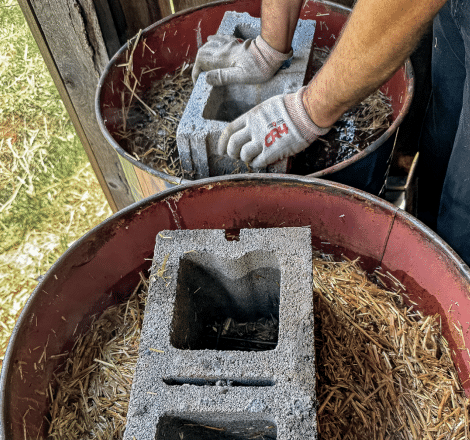
Monitor the water temperature and make sure it does not drop below 155°F (68°C) for the next ninety minutes. As long as the volume of water is huge enough, it should have enough thermal mass to maintain temperature. Otherwise, turn the heat back on and raise the temperature, keeping it below 170°F.
- After the ninety minutes have passed, remove the weights, then operate a fork to remove the straw from the water and place it on a pristine table or tarp to drain and chilly. If you pasteurize a diminutive amount, you can drain the water through a strainer instead.
- Once the straw has cooled to the touch, it should be inoculated with sawdust spawn. Wash your hands and then spread the spawn evenly onto the cooled straw. We have determined that a 6-pound bag of sawdust substrate will inoculate one full bale of straw weighing 40 to 60 pounds (18 to 27 kg).
- Collect the inoculated straw and place it in plastic bags or prepared food-grade buckets. Once packed, close the bags with zippers or put lids on the buckets.
- Operate pins to poke holes in the bags to allow fresh air to circulate. We make two rows of holes on opposite sides of the bag. If using buckets, cover the holes with microporous tape or fill the holes with fiber filling to prevent insects from entering and allow for fresh air exchange.

Leave the bags or buckets in a place where the temperature will not drop below freezing.
The lower the temperature, the longer straw colonization takes. Once the straw is fully colonized, which will take about twenty days, cut larger holes in the bags or remove fiber or tape from the bucket holes. Add moisture to encourage fruiting.
