

Cattail feeding and cooking
Chances are you’ve seen a cattail growing on the shore of your local lake or stream at least once or twice. Instead of just passing by these plants, try getting them and cooking them to create delicious seasonal dishes!
Known for their lofty stature and distinctive flower heads, cattails grow near lakes and swamps. Not only do they play a key role in their ecosystems, but they also provide various benefits to foraging enthusiasts and crafters alike. From edible shoots and roots prosperous in nutrients to pollen used in baking, cattail has many uses.
The following excerpt is from the book The Novel Wildcrafted Cuisine by Pascal Baudar. It has been adapted for utilize on the Internet.
(Photos courtesy of Pascal Baudar unless otherwise noted.)
What are Cattails?
Cattle (Typha latifolia) is one of the most versatile wild plants and can be found virtually anywhere in the United States.
This plant loves water and can be found growing on the shores of lakes, streams, swamps, swamps or in very wet soil. When mature, it usually reaches a height of 5 to 8 feet. It can be easily recognized by its stiff, flat leaf blades.
In the center you’ll find an upright, rounded stem reaching up to 6 or 7 feet (about 2 meters) lofty. At the end of the stem, the flower head forms a cylinder densely packed with diminutive male flowers in the upper cluster and diminutive female flowers in the lower cluster.
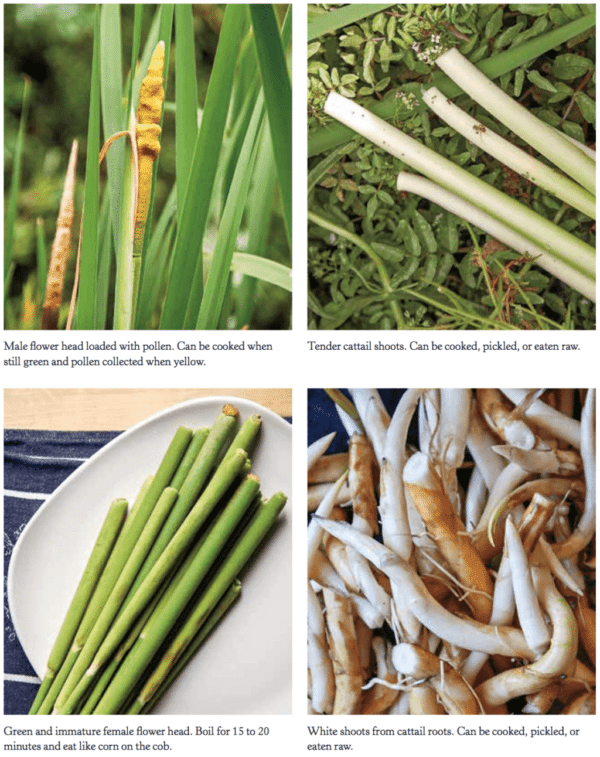
When the male cluster is loaded with pollen, it appears lithe yellow. Pollen is extremely straightforward to feed on in enormous quantities.
The bottom of the stem, picked at the right time, can be eaten raw or cooked. It is extremely vital to make sure that the water is not contaminated; do not pick chopsticks where there are a lot of people, horse riding, etc., because there may be harmful bacteria and even parasites in the water.
Anatomy of chopsticks
The lower end of the stem looks very similar to a leek. Using a knife, cut off the bottom stem (about 10 to 12 inches). [20 to 25 cm]) and place it in the feeding bag. Once you get home, immaculate the stems thoroughly; I usually utilize three changes of water to immaculate the stems.
The inside of the stem is very exquisite – you may need to remove one or two layers to get to the exquisite stem.
You’ll have to get your hands filthy if you want to harvest the starch-filled rhizomes. In spring I am always interested in collecting very juvenile, white shoots growing from the root; these shoots are quite exquisite.
Application for Cattails
The feeding season for cattail shoots usually takes place in early spring, while pollen collection occurs in May or June. In Southern California we sometimes have a fall and spring season.
In addition to food uses, indigenous people used the long, flat leaves to make hats, roofing materials, sandals, and woven baskets. The dried leaves were even twisted to make dolls and various toys for children.
Medically, the crushed roots can be applied to burns, bruises, or cuts to speed healing and relieve pain.
Foraging and culinary tips for the cattail

Roots
The roots are usually several centimeters below the ground. Collecting them can be a messy and messy job. Often you have to get into the mud, dig with your hands and pull it out.
When I first ate them, I was a bit surprised by the fact that they were very fibrous and spongy. I expected them to be a bit exquisite.
Cattail root is not something that can be eaten or cooked as is.
They are laden with starch, which must be extracted to make flour by chopping the roots into diminutive pieces and grinding them in water. Another option is to scrape off the starchy substance with a knife.
The resulting starch juice can be used in primitive bread recipes, or the starch can be collected for future utilize after it settles to the bottom of the container and dehydrates.
A real delicacy are the juvenile, exquisite, white shoots that grow from the roots in spring. Feed them carefully as they break easily. They can be boiled or pickled.
At the Melisse restaurant, they are cut into hefty slices and cooked like scallops with an appropriate sauce.
He shoots
The lower end of cattail stalks is my favorite forage. It can be eaten raw or cooked. It looks very similar to a leek and can be cooked that way. It’s quite good fried, but we usually cut it into skinny slices and add it to salads raw.
The taste resembles cucumber with a nutty note. This is delicious.
I usually pull off the two main outer leaves and then grab the remaining inner leaves and gently pull them. This is best done when the plant is growing in water. Depending on the season, location and age of the plant, the first 4-10 inches are tender and edible.
Flowers
Around May or June (and again in the fall here in Southern California), cattail pollen can be collected from the upper cluster (male flower part) by shaking it into a bag.
This pollen can be used as a very colorful yellow flour for bread and cookies. In a good location, I managed to get 2 or 3 cups an hour.
There is usually a fair amount of fluffy material mixed with the pollen. Remove it by straining the flour using a regular kitchen strainer.
Before placing the pollen in a jar or paper bag, dehydrate it. I place it on a enormous flat plate in the drying rack for a few hours; you can also set the oven to the lowest temperature, leaving the door open an inch or two.
If the moisture is not removed, it can cause the pollen to mold and spoil.
The still juvenile and green lower clusters (female flower part) can be eaten like corn on the cob after 15-20 minutes of cooking. Just add a little butter, salt and pepper and you have a delicious treat. The unripe, still green male flower can also be boiled for 10 to 15 minutes and is very tasty fried.

RECIPE: Pickled Cattail Shoots
Ingredients for each jar
- 8 medium-sized cattail shoots
- 1/4 California bay leaf (or 1/2 regular bay leaf)
- 2 diminutive chili pods – these are optional, but I like a bit of a hot kick (your choice of chili will determine how sturdy you get it – I usually utilize dried whole Japanese chili peppers)
- teaspoon (6 g) of sea salt
Pickling solution
- 3 cups (709 ml) apple cider vinegar (acidity 5%)
- 2 cups (473 ml) sweet white wine or elderberry white wine (from Mexican elderberries)
Procedure
- Thoroughly immaculate the cattail shoots and reserve the tenderest parts, usually about 5 inches. Remove outer layers if necessary.
- Wash the jars thoroughly and then place the shoots and remaining ingredients in them. I keep the jars slightly heated by placing them in a few inches of heated water. This is because I had a few (chilly) jars crack when I poured the heated pickling solution into them.
- Follow the instructions for Basic Water Bath Maintenance (on page 38 of the book). Bring the marinating solution to a boil and pour it slowly into the heated jars, leaving 1/2 inch headspace. Remove air bubbles with a immaculate spoon or knife. Your cattail shoots will tend to float; you will need to press them down when placing the lids on the jars.
- Put it in the fridge and enjoy the taste after a few weeks. If you want, you can preserve them using the water bath method: pour boiling water over them for 25 minutes.