
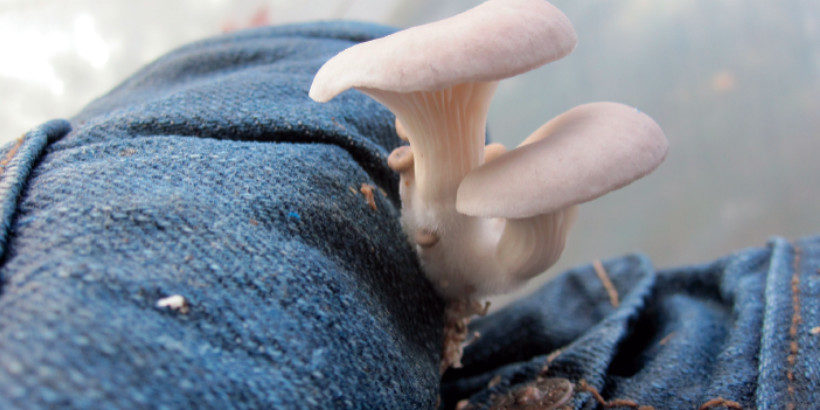
Grow mushrooms on your jeans. Seriously.
Do you have venerable, worn jeans in your dresser? Instead of throwing them away, try growing mushrooms on them.
Follow this plain step-by-step diagram to start growing mushrooms in the most unlikely places… on your pants!
Below is an excerpt Organic mushroom cultivation and mycoremediation By Cotter said. It has been adapted for apply on the Internet.
(Photos courtesy of Tradd and Olga Cotter unless otherwise noted.)
How to grow mushrooms on clothes
I started growing mushrooms on clothes when I first became interested in mycormediation of dye and pigment waste. There was a textile factory near our farm that produced denim for jeans and other clothing. One day my wife Olga and I went to the mill and were greeted by some amiable people. I told them I was interested in remediating the indigo carmine they were allowed to release into waterways based on EPA daily allowable standards.
They looked at me a little nervously, as if I was an undercover environmental activist blowing the whistle; Picking up on this, I quickly told them about my research and passion for mycoremediation. The man I was talking to happened to be the owner and was excited to hear about the prospects of reducing the mill’s environmental impact.
Experiment: growing mushrooms on clothes
The following week I decided to grow mushrooms on venerable jeans to see if they could discolor the indigo carmine that gives them their blue color.
My first experiment was a success, the oyster mushrooms colonized very well and fruited on venerable cotton jeans, but the discoloration of indigo carmine that I expected was not perceptible. Turkey tail mushrooms and a few other species are more effective in the discoloration process, but I have learned that venerable cotton clothing can encourage oyster mushrooms to fruit. (This could be potentially valuable survival information for anyone directly affected by a natural disaster where there is a huge amount of garbage but little food.)

Folding a pair of jeans. After inoculating the jeans with the spawn, roll up each leg and leave the pants for a few weeks to give the mycelium time to colonize.
To grow mushrooms, you can apply venerable cotton shirts, pieces of rugs, hemp and sisal ropes – any material consisting of natural plant fibers, including cotton, hemp and bamboo. To start, all you need is water and a bit of oyster mushroom mycelium.
Grow mushrooms on clothes in 6 steps
- Soak the clothes in fresh water. The water does not have to be sterile and neat, it just needs to be free of ponderous metals.
- Lay out the clothes on a flat surface. Sprinkle the surface sparingly with the mushroom starter culture. Remember, more spawn will speed up the process, but it won’t necessarily produce more mushrooms.
- Roll up clothing tightly or, if you have more than one item of clothing, arrange it in stacked layers. Place the clothing in a plastic bag or closed container with several holes.
- During colonization, check the moisture of the garment every few days to ensure that the fabric does not droughty out; Spray or water if necessary. Room temperature or lower is ideal for colonizing clothing scraps.
- When a whole lot of clothing appears to have been completely colonized by mycelium, escalate ventilation by adding more holes or cracking the lid of the container, but not so much that the clothing dries quickly. Surfaces should be slightly moistened to induce fungus formation. The colonization process may take one to two weeks depending on how much spawn you apply. At this point, the mushrooms are not interested in fruiting, so delicate is not needed to stimulate fruiting.
- Once the mushrooms begin to emerge, which may be several days or weeks after colonization, depending on temperature and the amount of spawn used, they will double in size each day. Spray as often as necessary to prevent the mushrooms from drying out when youthful.
Once the mushrooms have stopped growing, they are ready to be harvested.