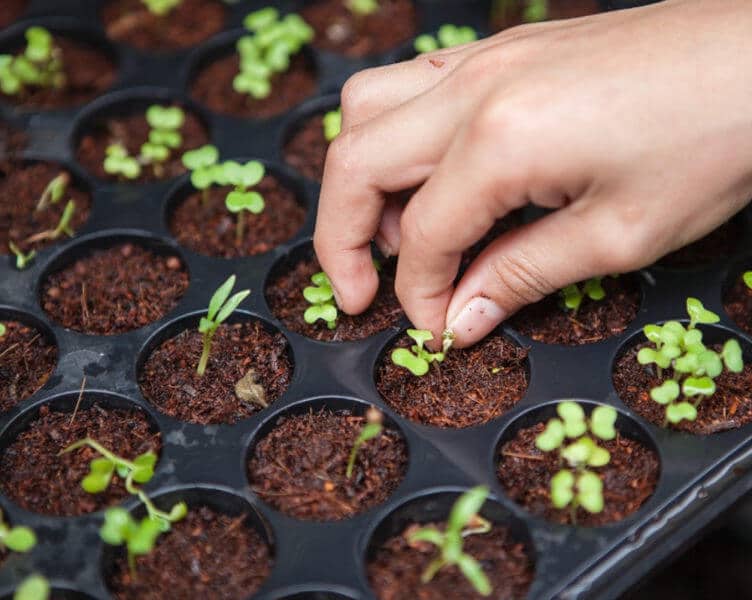
Grow your own vegetables – starting plants from seeds
Growing your own vegetables may be easier than you think! All you need is some space indoors or outdoors and some seeds and you’ll be planting plants in no time.
Below is an excerpt Fresh food from miniature spaces by RJ Ruppenthal. It has been adapted for exploit on the Internet.
Starting plants from seeds
Once you have chosen your location, the next step in your preparations should be check the last average frost date for your location. This is the approximate but very essential date mentioned on the back of many seed packets (e.g., “Plant plants three weeks after last average frost date”).
To find the average last frost date, check online or contact your local nursery or agricultural extension agent. An online chart for major cities is available on the website Farmer’s AlmanacHere.
One warning: the microclimate varies significantly, and in my area, a distance of a few kilometers can extend the frost date by a month.
Pay attention to temperatures where you live and how much they differ from the nearest point listed on these charts. The charts also show First the average frost date in autumn, which is worth remembering when planning the length of the main growing season.
Step 1: Start seeds in containers
You will need containers in which to start planting the seeds.
Think of the little seed trays that hold the seedlings when you buy them from a nursery; you can either buy several of these seedling trays, or you can exploit other miniature containers that can be filled with 2 or more inches of seed starting medium.
Petite yogurt containers or cut-out milk cartons work well, and you can grow a dozen miniature seedlings in an egg carton.
You can also reuse plastic pots, even larger ones, and plant as many seeds as you can fit in the space.
(Do not place them too tightly, however, as root growth is essential and you will need to remove them without damaging the root system.)
Make a few holes in the bottom of the plastic containers you exploit to ensure proper drainage. because too much moisture will kill the seedlings. Another option is to exploit peat or coir pots, which can be placed directly into the garden soil, thus relieving the stress of repotting.
Maximize your chances of success
When it comes to planting dates, follow the recommendations on the back of the seed packets in conjunction with what you have learned about the last frost date.
To maximize your chances of success, you can try two or three plantings of the same seeds, each a week or two apart. This way, when the first pepper plants are ready to go in the ground, the next set will be delayed by just two weeks.
If you find that there has been a tardy frost and the first wave of peppers wilt, you have a spare set ready to exploit.
By using this method, you can save time and also challenge the seasons with a little more confidence: If you can’t afford to lose everything by planting seedlings early, you may want to risk planting very early.
Sowing substrates
Put some seeding medium into the containers. This can be garden soil, provided it has enough organic matter to make it fairly lithe, but it will need to be sifted to prevent larger pieces of material from entering.
Sieved peat is a good starting substrate. You can also buy good soil for pot seeds in nurseries (overpriced, but one bag is enough for some time).
When I start planting, I always add a tablespoon of compost or worm castings; you don’t want to burn youthful plants with fertilizer, but these changes tardy the release of nutrients and aid strengthen the youthful plant’s immune system.
Another option is to exploit starting blocks or pellets sold by some seed companies and nurseries.
For anyone using peat products to start seeds indoors, I have two pieces of advice:
Some people believe that peat moss is harvested in an unsustainable and environmentally irresponsible way. If, after researching, you agree, look for a nursery or online store that sells an alternative to coir that works just as well and is sustainably harvested. Another company introduced seed planting pots made from composted cow manure, which is certainly a renewable resource. If you can’t find these locally, check them out Cowpots.com.
Pots and peat disks are often contaminated with rootworm eggs. This can be a massive problem if you’re growing seedlings in your own home, because within a few weeks of planting, little bugs eat the seedlings’ roots and a cloud of fruit fly-like insects. To sterilize the peat substrate before using it, either soak it in a 50/50 solution of water and hydrogen peroxide (allow about a day for it to evaporate before planting) or put the damp peat products in the microwave for two minutes at maximum power, which should also kill everything. (Be careful not to lithe the fire as cooking times may vary, and make sure your significant other is not home at the time as your kitchen will smell very earthy.)
Plant the seeds according to the directions on each seed packet.
Don’t bother planting beans and peas; they do not transplant well and it is better to sow them directly in the garden. You can plant two or three seeds in a container or block and then lean the plants later, or you can take the risk and just plant one.
Early in the season, even indoors, seeds will benefit from heat and moisture to germinate.
A good way to achieve this is to place a plastic bag over the containers. A clear plastic food tray also makes a good cover.
Bottom heating speeds up the process and allows you to start sowing earlier; you can buy a heating pad for the seedlings from a nursery or place them on a toasty surface, such as the top of the refrigerator.
As soon as the seedlings start to emerge, remove the bag and start providing them with some lithe. If you have a bright window, place it there with a little shade. (A well-placed curtain, cloth or plastic bag will allow for diffused sunlight that won’t burn the youthful plants.)
If using a lithe, a fluorescent or CFL bulb should be on for 12 hours a day (more is fine, too), and the location should be a few inches from the tops of the seedlings to provide them with enough concentrated lithe.
Water the seedlings gently from the top of the soil or by placing the seedling containers in a tray of water until the soil appears saturated. Make sure they drain well and don’t flood them; this is the main cause of seedling failure.
Choose only the strongest (bushiest) plants and lean out those that are spindly and slower-growing.
Many people suggest that once the seedlings are established and growing, run your hands over the leaves every time you walk by to mimic the wind and encourage the plants to grow in response. About a week before the seedlings are planted in their final earthly destination, they should be “hardened off.”
This is a step that people too often neglect, and essentially means allowing the plant to slowly adapt to the temperature and climate of its fresh home.
This can be done by taking the seedlings outside for a brief time every day and gradually extending this period. Don’t place them in a brilliant, bright or windy place at first.
On the first day, we put them outside for half an hour, in filtered sunlight. On the second day, leave them for an hour.
On the third day, leave them for two hours. Then half a day, then the whole day, bringing them in in the evening. If they are intended for windy locations, you can start giving them a bit of the usual wind, initially protecting them if necessary.
Wind can actually make a seedling stronger and more vigorous, but only in miniature doses.
After a week, leave the plant outside all day and night in its fresh location, and plant it the next day.
Place the pot with peat or coconut directly in the ground; for other potted seedlings, first moisten the soil in the pot and final location, then slowly remove the plant and soil, and be careful not to damage the stem or leaves when transferring it to the planting hole.
If nighttime temperatures are still near freezing when you plant your plants, cover each plant overnight with a plastic yogurt container, a milk carton, or a soda bottle cut in half: These can be inexpensive season extenders if they aid you get your plants in the ground earlier.
But when in doubt, don’t risk your plants freezing: Wait a little longer to plant them, until the danger of frost has passed (unless, of course, you have another set of seedlings ready as a backup).
Before I plant warmer weather vegetables, I always look at the weather forecast and make sure their first week in the ground will be toasty; this helps them get off to a good start.
If you manage the “hardening off” well and allow the youthful plant to slowly adapt to fresh conditions, then it will produce food for you faster than a direct seeded plant. Using transplants can also extend the time it takes to grow your last crop.
However, if the plant becomes stressed during transplanting, its yield will decline and it may not survive at all, wiping out the time you saved by starting your grow indoors.