

Hedges: a paradise for wild greenery
Are you wondering where to look for greens in spring? Look no further than hedgerows, which serve as natural habitats for wild vegetables and herbs!
Below is an excerpt Hedges by Christopher Hart. It has been adapted for utilize on the Internet.
Food from the hedgerows: salads and vegetables
Let’s start by taking a look at all the wild foods and medicines available in the hedgerow at Underhill.
After blackberries, most people are probably familiar with the abundance of green leaves in the hedgerow in March. And the selection of this particular salad bar can be dazzling.
For example, Underhill Hedge itself offers cleavers, ramsons/wild garlic, cow parsley, dandelion and a wooden jetty.
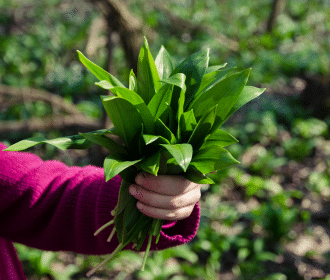

Wild garlic
Wild garlic, like all spring vegetables, is delicious quickly sautéed in butter, but it also makes a fantastic soup when mixed with equal or roughly equal amounts of nettle tops and good bone broth.
And the absolute best thing you can do with a leaf or two of wild garlic and/or dandelion is put them right in your Cheddar cheese sandwich when you go for a long spring walk.
We have already mentioned cleavers or goose: the best and most established thing you can do with this hearty plant of many hedges is, as the name suggests, feed it to a goose and then eat the goose.
But you can also lightly fry the newborn shoots and eat them directly.
And yes, all species of docks (Rumex) are edible – in moderation.
Eating wild foods: less is more
The general rule is that all wild foods should be eaten in moderation. Our ancestors ate a wide variety of plant foods, and even today, the Kalahari Bushmen regularly eat over a hundred different types of plant foods.
So, for example, you shouldn’t eat too much oxalate because it contains quite high levels of oxalates, which can cause kidney stones.
But so are rhubarb, spinach and almonds and no one is saying they are bad for you. Even broccoli contains harmful substances such as thiocyanates. If you ate five kilograms of broccoli in one sitting, you would probably die. But people don’t do it anyway.
Generally speaking, it’s best to have a little bit of everything. One of the few food groups that does not contain nutrients is meat – because an animal’s favorite way to avoid being eaten is to hide, fight or run away.
Plants can’t hide or run away, so they fight against anti-nutrients – except, of course, fruits, which want to be eaten so that their seeds can be spread around the area when they urinate.
It’s all really very basic.
Back to the hedge salad.
Make a hedgerow salad
You can also add some hawthorn leaves and wild rose and dog rose petals to make it really fancy and create a stunning salad with just that one section of hedge.
Another Underhill hedge plant on Jenny Bennet’s list is common rush, also considered edible by some; apparently it is well known in Chinese herbal medicine, while the Japanese make a tea from it called hui sup. But I haven’t found much solid evidence of its edibility, let alone deliciousness.
Many wild foods fall into the “may be edible – not entirely clear” category, and if so, I recommend caution.
Wild foods tend to have a forceful flavor compared to the insipid mush we’re used to buying from the supermarket. However, it is these forceful, slightly bitter flavors that signal its nutritional value. As the year progresses, protective chemicals build up on the leaves and I wouldn’t recommend most of them after May.
Nettles: warnings and notes
The only minor exception to this rule are nettles, if they grow in their own bed. Of course, they need to be cooked first: steamed, plain or fried in butter.
But when May or June comes, if you cut the nettle bed back to the ground – and assuming there is good summer rain – in about three weeks, you will have a completely novel crop of vivid, newborn nettle shoots that you can eat a second time.
I ate newborn nettle tops only in October, without any negative consequences. However, if you try to eat fibrous older nettles after June, you will find that: a) they taste bitter; and b) have a laxative effect.
You have been warned.
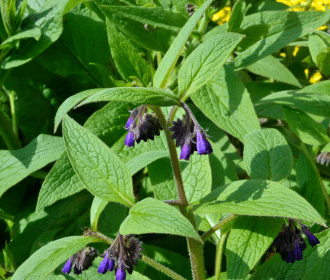

Comfrey leaves
By the way, comfrey leaves have only recently disappeared from the menu, although many older books on wild foods recommend them. They are now known to contain enormous amounts of rather toxic alkaloids.
Pliny recommended adding them to braises, Culpeper recommends them too, and even John Lewis-Stempel enjoys comfrey pancakes, reminding us along the way that comfrey “has more protein in its leaf structure than any other wild plant in Britain.”1
However, if you’re avoiding comfrey, you can still utilize its ‘leaves in cake’ recipe with something else by brushing the leaves with duck egg yolk and then frying them in goose fat, chestnut flour and hazelnut oil.
Sounds fantastic. How about wild garlic and a few very newborn horseradish leaves?
Hawthorn leaves are probably the best tree leaves to eat in spring (although you can also try beech and linden).
Village children called them bread and cheese, in honor of which Streeter and Richardson suggest placing a bunch of fresh newborn hawthorn leaves on pieces of fried bread, sprinkling with cheese and grilling until bubbling.2 Delicious.
The healing power of yarrow
The name itself contains a forceful and subtle clue to the health benefits of yarrow: it is related to the Senior English word for healer, gearwe, while other folk names include rannik and staunchwort. The Romans called it herba militaris, “soldier’s herb”, because of its healing properties.
It used to be used instead of hops to preserve and flavor beer, and I made a 24-hour cool infusion with yarrow and meadowsweet flowers that was excellent.
You can also do something Anglo-Saxon with your beer by adding a herb or other suitable herb – flowers or leaves – into the glass before pouring wine or ale. Exploit peppery herbs for wine, peppery herbs for beer, and leave them to infuse for a few minutes.
The results are pleasantly unpredictable.
Foraging: From then to now
The truth is that compared to our ancestors, we are now terribly monotonous at foraging and cooking.
Consider a preserved recipe for an English herb omelet from the early Middle Ages: it contained 16 eggs, chopped dittany, rue, tansy, mint, sage, marjoram, fennel, parsley, beetroot, violet leaves, spinach, lettuce and crushed ginger.
Who would mix ginger with eggs and mint today? But it can be delicious. Violet leaves are edible; tansy and rue are often overlooked as senior
English potted herbs and an senior herb garden ingredient, lovage; and dittania was now almost entirely forgotten.
Your teeth
I actually consider it to be what is more commonly called dittander, also incorrectly dittany (Lepidium latifolium), another member of the cabbage/brassica family, so many of them have forceful health properties, rather than dittany Dictamnus albus which doesn’t look edible.
Dittander is a perennial plant found in wet areas near the coastused as a peppery spice before the introduction of horseradish from the Middle East and recommended by medievalists for leprosy, hence its constant presence in the hospital of St. James and Saint Mary Magdalene in Chichester, founded in the 12th century.3
What about carbohydrates, an often sought-after delicacy for the novice wild forager? Roots and tubers are one of the best and healthiest sources of carbohydrates – healthier than grass grains such as wheat and barley. Have you ever heard of someone who had an intolerance to potatoes or sweet potatoes? This is very occasional.
The first feed food
But what did a wild food forager eat before growing the humble spud or the earliest grains of spelled and emmer?
John Lewis-Stempel maintains that we ate argenta tubers in Britain before the arrival of potatoes, which is convincing, but I imagine that in very historic times we ate dozens of different bulbs, roots and tubers: silverwort, burdock, horseradish, wild garlic, rushwort and undoubtedly many others that we have forgotten about.
Silverwort and common reed, as well as flowering rushes, reeds and other plants that grow in ditches and wetlands, have roots that can be baked and then ground into flour.
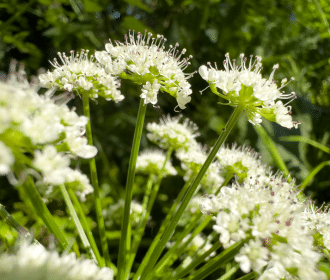

Pignut: the basis of hedges
But another absolute staple – and one that shows up at Underhill – is the pignut.
You really have to hit the Paleolithic here with a pointy digging stick, but if you’re into that sort of thing, it’s fun.
You dig straight down next to the pignut and then a little further to find a walnut-sized tuber that is always at right angles to it.
“Sweet chestnut crossed with radish” is a very good description I’ve heard. It is excellent to eat, especially roasted, like all roots.
I should add that Culpeper warns us that the pignut may be a little too good for you and “excite the desire immensely and excite the sports of which it is a champion.” Treat with care.
Hedge garlic
Another root that can be found everywhere and eaten with a clear conscience because it is so common is hedge garlic. It’s a bit like horseradish.
Grate it raw on almost anything to add spice: baked potatoes or steamed vegetables, fresh salads, add a little oil; it’s a wonderful aroma. And being a cabbage from the cabbage family, it has enormous health benefits.
Gently cultivate along the entire hedge.
Wild garlic
However, my absolute favorite wild green is wild garlic. If you mix them in 50/50 proportions with newborn nettle tops, it will become a fantastic addition to vegetables, but it will also make a great pesto.
The original Italian version contains pine nuts and Parmesan cheese, of course, but you can make a delicious British equivalent (actually, it’s probably cultural appropriation) if you mix together a handful of raw wild garlic leaves, some toasted hazelnuts, any forceful difficult cheese, and a good drizzle of olive oil.
Blend in a food processor and swallow.
Notes
1. John Lewis-Stempel, Wild Life (London: Doubleday, 2009), 197.
2. David Streeter and Rosamond Richardson, Discovering. Hedgerows (London: BBC Books, 1982), 51.
3. Richard Mabey, Flora Britannica (London: Chatto and Windus, 1996), pp. 152–53.