

Below the mushroom cap: Mycelium and its secrets
How do mushrooms grow? How do they eat, reproduce or spread? What exactly is a mushroom? All these answers and more can be found in the intricate, web-like fiber found beneath these mushrooms: the mycelium.
Understanding this “vegetative” part of the fungus is key to understanding the entire system.
Below is an excerpt In search of mycotopia By Doug Bierend and has been adapted for utilize on the Internet.
What Is Mushroom?
Whether you tripped over them or just enjoyed them on pizza, most mushroom encounters involve mushrooms. The totally popular “button” variety from the supermarket might come to mind, or perhaps the pale, little umbrellas common in fields and suburban lawns.
But mushrooms are a universe unto themselves, expressing every imaginable (or, as you soon discover, often unimaginable) form and texture.
Types of mushrooms

Some look like living icicles or a surreal vision of bloody teeth; many of them look like small cups of barnacles on a twig or spots on a leaf that the human eye never notices.
Some varieties bruise into sizzling rainbows when sliced, or melt into inky puddles after a few hours above the ground. Many mushrooms may seem supple and spongy, but they can grow with enough force to break through pavement or lift rocks.
Popular names of mushrooms
Their common names – pheasant’s back, witch’s butter, wooden ear, elf’s saddle – are often so apt that they are impossible to forget once you learn them. They also contain a seemingly endless variety of meanings.
Depending on who you ask, mushrooms evoke thoughts of delight, disgust, delicacy, divinity, or death. When encountered in nature, they can seem to vibrate with an inexplicable sense of presence and even personality; many mycophiles talk about “meeting” mushrooms in the forest.
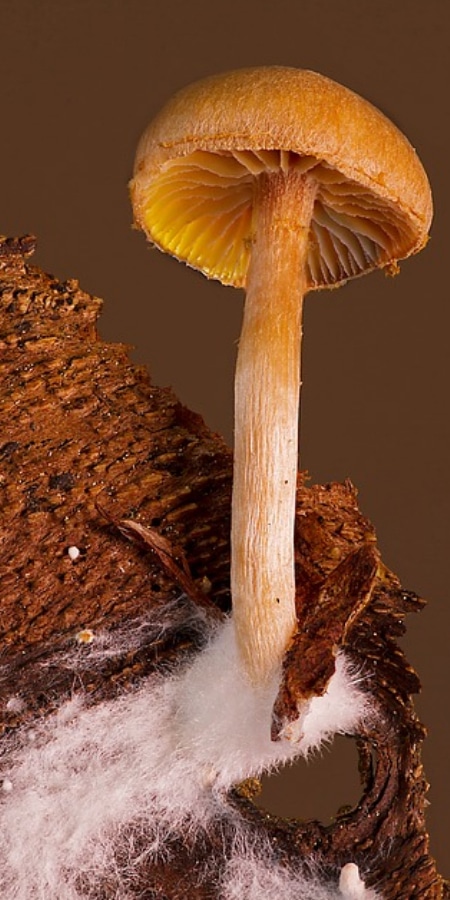
But mushrooms are just the tip of the fluffy iceberg, pointing to the dense tangle of living fibers below: the mycelium.
Mycelium and its secrets
It is a subdued white spot that can be seen by lifting a log of rotting leaves on a damp forest floor or by examining the side of a fallen tree. Called the “vegetative” part of the fungus – apparently a remnant of its inclusion in the plant kingdom – the mycelial mat in which the entire life cycle of the fungus takes place is often very compact, no larger than an ant or a handful of leaf cells.
Others may occupy a few acres and live in the hundredsor even thousands of years. When one becomes interested in mushrooms, one often hears about the Humongous Fungus high in the Blue Mountains of Oregon; its network of mycelial “body” extends over three square miles, giving it the distinction of being the largest living thing on earth, as well as one of the oldest.1
What is mycelium?
Mycelium forms a elaborate network of cellular strands called hyphae.

Viewed up close, and best seen under a microscope or time-lapse camera, hyphae resemble ice crystals in an ever-expanding search for food, whether in wood, leaves, insects, rocks, bacteria, bones, or in symbiosis with another organism.
Mycelium functions
Along each part of its surface, enzymes are secreted to digest food, which is then absorbed back into the walls of the filamentous cells; instead of chewing, swallowing and digesting food, fungi reverse this scenario by growing, dissolving and absorbing their food. Fungi excrete a variety of secretions, including those that serve to combat other microbes or attract potential mates as their body web expands its reach and negotiates the environment.3
Because the individual hyphae are so lean – down to a few thousandths of a millimeter – the mycelium folds a huge surface in a compact space.4 Because the mycelial network grows from almost every leading edge, it can add more than half a mile of hyphae each day. As much as eight miles can be found in a cubic inch of prosperous, undisturbed soil; in more complex conditions, this length may be reduced to one hundred centimeters.5 The incredible delicacy of the hyphae allows them to move intricately between and within plant roots, between microscopic cracks in stone, and even inside individual host cells..

What is mycelium made of?
Mycelium consists of millions of filamentous cells, with no clear center. Split it in half and the two sections will continue on with their day. Split it into tens of thousands of microscopic pieces, and each fragment independently resumes its search for food and mates, reuniting wherever they encounter another part of their former, larger selves.
From tip to tip of the hyphae, the fungus regulates the flow of energy and information in different zones of its dispersed form: Where there is nutrition, energy is consumed and distributed throughout the mycelium; where threats exist, it can assemble an arsenal of adaptive defense mechanisms.
And there are always threats. In nature, fungi live in constant, deadly competition with bacteria, insects and other fungi that want to eat them or take over their resources.6
If the harvest seems compact or local conditions have changed, the mycelium may decide – if that’s a “decision” – to withdraw, explore recent options, or start producing mushrooms.
When you look at the forest floor and see mushrooms (luckily), it’s because the mycelium underneath has decided it’s time to throw in the towel.
Literally in the form of spores. Mushrooms are also commonly called fruiting bodies, another linguistic relic of their long-standing classification as plants.
Not to be outdone by their botanical namesake, mushrooms come in all sorts of compelling and colorful shapes that rival flowers in beauty and complexity, but their unifying purpose is to reproduce, and if we’re being straightforward, that’s often quite obvious just by looking at them.7
Comments:
- By comparing the mushroom’s size with how quick it spreads – about one to three feet per year – scientists estimated it to be between 1,900 and 8,650 years venerable; see Craig L. Schmitt and Michael L. Tatum, “Location of the World’s Largest Living Organism at the Malheur National Forest [The Humongous Fungus]“United States Department of Agriculture, Forest Service, Pacific Northwest Region (2008), 4, https://www.fs.usda.gov/Internet/FSE_DOCUMENTS/fsbdev3_033146.pdf.
- Gero Steinberg, “Hypha Growth: A Story of Motors, Lipids and Spitzenkörper”, Eukaryotic cell 6, no. 3 (March 2007): 351–60, https://doi.org/10.1128/ec.00381-06.
- Cotter, Organic mushroom cultivation7–8.
- McCoy, Radical mycology14.
- Phillips, Mycorrhizal planet6.
- Fungi can also parasitize other fungi. Perhaps the most frequently cited example is the delicious lobster, which, when heated, forms a distinctive red “shell” on its surface. Hypomyces lactifluorum parasitizes the species Russula Or lactationtaking it from flat or too peppery to crispy and tasty; see Tom Volk, “This month’s mushroom is Hypomyces lactifluorumLobster Mushroom”, Tom Volk’s Mushroom of the Month for August 2001accessed August 6, 2020, https://botit.botany.wisc.edu/toms_fungi/aug2001.html.
- Shameless phallusfor example, it is a slender, pale, sometimes slightly curved mushroom with a dim, rounded tip that is undeniably similar to, well, you get the idea.